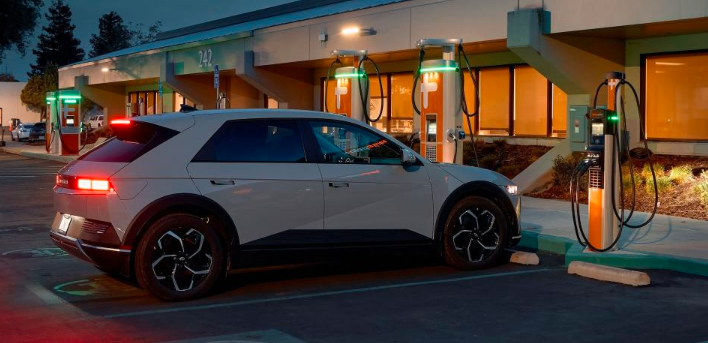
As the adoption of electric vehicles (EVs) gains unprecedented momentum across the globe, the demand for fast, efficient, and accessible charging infrastructure is increasing significantly. One of the most vital components in this growing ecosystem is the ev dc charger. Unlike traditional AC chargers, which rely on the car’s onboard converter, the ev dc charger supplies direct current directly to the battery, enabling much faster charging times.
In this article, we’ll explore the importance of ev dc charger technology, its benefits, key use cases, how it compares to AC charging, and what the future holds for DC charging infrastructure in a rapidly electrifying world.
Understanding the ev dc charger
An ev dc charger (Electric Vehicle Direct Current charger) is a high-power charging device that delivers electricity directly to an EV’s battery by bypassing the vehicle’s onboard AC-to-DC converter. This drastically reduces charging time and is especially valuable in public and commercial charging settings where drivers need a quick energy boost rather than a slow overnight charge.
While AC chargers are commonly used in homes and offices for overnight charging, ev dc chargers are strategically placed along highways, at fleet depots, and at commercial stations to minimize downtime and maximize vehicle uptime.
How Does the ev dc charger Work?
The basic function of an ev dc charger is to take alternating current from the grid, convert it into direct current via an internal converter, and then deliver it to the EV’s battery pack. Power Output: Ranges from 24 kW to over 350 kW
- Vehicle Acceptance Rate: The car’s battery and thermal management system must support high charging rates
- State of Charge (SOC): Fast charging is quicker when the battery is at a lower SOC
- Connector Type: CCS, CHAdeMO, or GB/T
The most common standard in many countries today is the CCS (Combined Charging System), which supports both AC and DC charging through a single port.
See also: Choosing the Perfect Live Auction Software: A Complete Guide for Business Success
Key Benefits of the ev dc charger
🚀 High-Speed Charging
The most prominent advantage of the ev dc charger is its ability to charge an EV up to 80% in 20–45 minutes, depending on the power level. This makes it ideal for highway rest stops, taxi fleets, logistics vehicles, and long-distance travel.
🔋 Battery Efficiency
. As a result, energy is delivered directly to the battery, making the process more efficient and less time-consuming.
🌐 Commercial Flexibility
Whether it’s a shopping mall, fleet management company, or service station, having a fast ev dc charger means faster vehicle turnaround, better customer satisfaction, and higher throughput for charging service providers.
🛠 Advanced Monitoring and Control
Most ev dc charger units come with cloud connectivity, allowing real-time monitoring, diagnostics, payment processing, and remote firmware upgrades—crucial for network operators and smart city planners.
Types of ev dc charger by Power Output
| Charger Type | Power Rating | Typical Use Case |
| 24–50 kW | Entry-Level DC | Urban stations, commercial plazas |
| 100 kW | Mid-Range DC | Highways, public stations |
| 150–350 kW | Ultra-Fast DC | Intercity routes, EV fleets |
The choice of charger depends on the type of vehicles being served and how quickly drivers need to recharge. While 24–50 kW chargers suit most city EVs, 150+ kW chargers are ideal for high-end models and commercial EVs with larger battery packs.
Where Are ev dc charger Units Most Commonly Installed?
🏢 Commercial Properties
Shopping malls, restaurants, and hotels install DC chargers to attract EV owners who want to top up while they eat or shop.
🚚 Fleet Depots
Logistics companies, public transportation agencies, and taxi services increasingly depend on DC fast charging to keep operations smooth and minimize vehicle downtime.
🏙️ Urban Fast-Charging Hubs
In cities with limited residential parking, fast charging hubs with multiple ev dc charger stations allow users to charge on-the-go within short timeframes.
Future of ev dc charger Technology
As EV battery technology improves, DC charging will become even faster and more efficient. Some future trends include:
- Bi-directional Charging: Allowing EVs to send power back to the grid (V2G or V2H)
- Wireless DC Charging: Under-development systems aim to eliminate cables entirely
- AI-Powered Load Balancing: Smart systems to balance energy draw and prioritize vehicles by need
- Solar Integration: Solar-powered DC stations with battery storage for remote areas
By 2030, the majority of public charging infrastructure is expected to be dominated by ev dc charger systems due to their scalability and convenience.
Popular Manufacturers of ev dc charger Units
Several global and regional players lead the ev dc charger manufacturing space, offering robust solutions for various applications. These include:
- ABB
- Delta Electronics
- Tritium
- Siemens
- EVBox
- Wallbox Supernova
- ChargePoint Express
These companies offer chargers with varying output power, advanced monitoring software, and compatibility with global standards such as CCS and CHAdeMO.
Conclusion
The ev dc charger is not just another piece of technology—it is the enabler of true electric mobility. As EV adoption rises, the need for faster, smarter, and more efficient charging infrastructure is paramount. DC fast charging bridges the gap between range limitations and convenience, allowing EVs to be as functional and spontaneous as traditional fuel-powered vehicles.
For cities, businesses, and fleet operators looking to stay ahead of the mobility revolution, investing in ev dc charger technology is both a practical necessity and a step toward a cleaner, electrified future.